
Twin prams in Australia: tandem vs side-by-side
Two configurations, two sets of trade-offs. What fits your car and your front door, and why pre-loved captures most of the value.
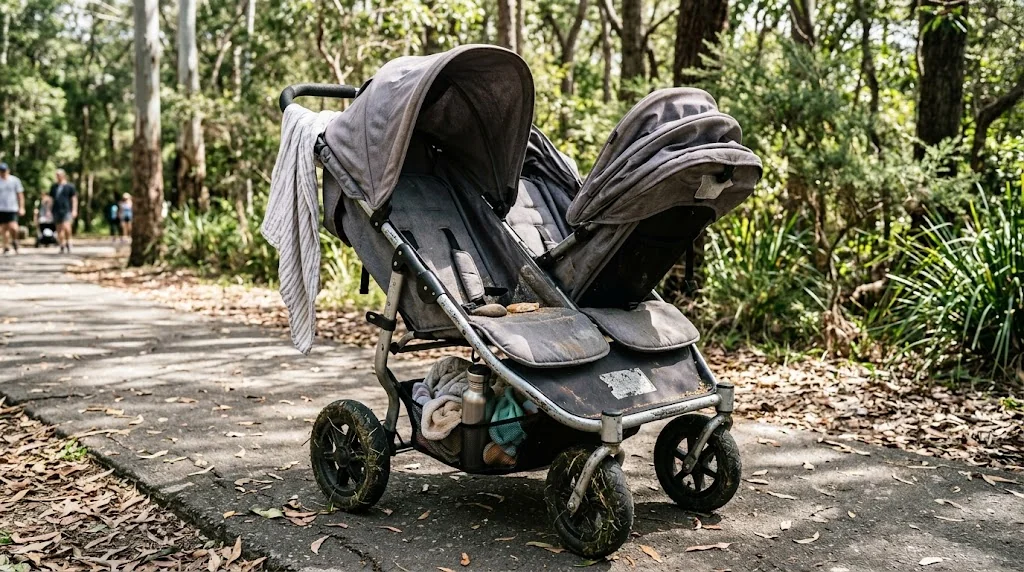
The two configurations
Every twin pram is one of two shapes, and the choice between them is mostly about your home and your car, not your babies. A tandem pram, sometimes called an inline, seats one child behind or above the other. It stays narrow, so it fits standard doorways, shop aisles and lifts, and it often lets one child recline while the other sits up. The cost is length: a tandem is longer, and with two children aboard it can be heavier to steer and slower around tight corners.
A side-by-side seats both children level with each other. Both get the same view out, and these prams are usually easier to fold and to push in a straight line. The catch is width. Many side-by-side doubles are too wide for a standard doorway, so measure your front door, hallway, lift and local shopping-centre aisles before you commit, not after.
The price reality
Double prams are expensive, and the range is enormous. CHOICE, Australia's independent consumer-testing body, has tested double prams and strollers spanning roughly $229 to $2299 (CHOICE double stroller buying guide). That spread is the whole argument for buying pre-loved.
A top-end double pram bought a season old saves hundreds, and at the upper end well over a thousand dollars, for gear your twins will use for a couple of years at most. Prams also hold up well and are easy to inspect, which makes them one of the better second-hand buys a twin parent can make.
What to check before you buy
These checks apply whether the pram is new or used, and they matter more with a double because everything is bigger.
- Boot fit. Fold it and make sure it actually fits your car boot. A double pram folded is still large, and this is the check people skip.
- Newborn suitability. For twins from birth, both seats should lie flat or take a bassinet or capsule. Check both sides, not just one.
- Total weight. Add up what you will lift: the frame, both seats, and two children. A pram you can barely carry up a step is a daily problem.
- Turning and kerbs. Push it loaded if you can. See how it handles corners, doorways and stepping up a kerb.
- Convertible option. If a second child may follow later, a single-to-double that converts can suit better than a dedicated twin pram.
Models and safety
The Australian market carries both dedicated side-by-side doubles and inline convertibles, and model names change year to year, so it pays to compare the current line-up rather than an old review. We will point to specific models and, in time, partner recommendations as we build this guide out.
Buying a double second-hand means the same safety and wear checks as any used pram, just doubled: run the recall check, test both brakes and both harnesses, and inspect both seats and the full frame. Our used pram checklist covers each step, and for a twin-specific view, Twinfo's guide to choosing a twin pram is a useful Australian read.
Measure first, choose second
Before you fall for a pram online, measure your front door, hallway and boot. The narrowest tandem or the widest side-by-side is the wrong pram if it won't fit through the door of your own home.
References
Prices and dimensions vary by model and change yearly, so treat these as a guide and check the current specs before buying.
- CHOICE, Double pram and stroller buying guide and reviews (independent Australian lab testing; tested price range about $229 to $2299).
- Twinfo, Choosing a twin pram (Australian twins-specific buying guidance).
Related reading
Find a twin pram worth keeping
Double prams are pricey new and used for barely two years. Buy one pre-loved from a family who looked after it, then pass it on when your twins move up.
Shop the marketplace