
Carrying two: twin carriers and tandem babywearing
Two single carriers, a dedicated twin carrier, or a pair of wraps. How to carry two safely, and what to check when you buy pre-loved.
Why babywearing earns its place with twins
With one baby, a carrier is convenient. With two, it can be the thing that gets you out the door. Wearing a baby frees your hands, and it can settle a fussy twin against your chest while you deal with the other. Healthdirect's guidance on raising and feeding twins makes the practical point that soothing and hands-free care matter a great deal when you are outnumbered.
There is a space argument too. A double pram is wide, and it does not fit everywhere: narrow shop aisles, busy cafes, crowded public transport, bush tracks. Being able to carry one or both babies is the difference between going somewhere and staying home.
The three ways to carry two
There is no single right setup. Most twin parents settle on one of three approaches, and many mix them depending on the day.
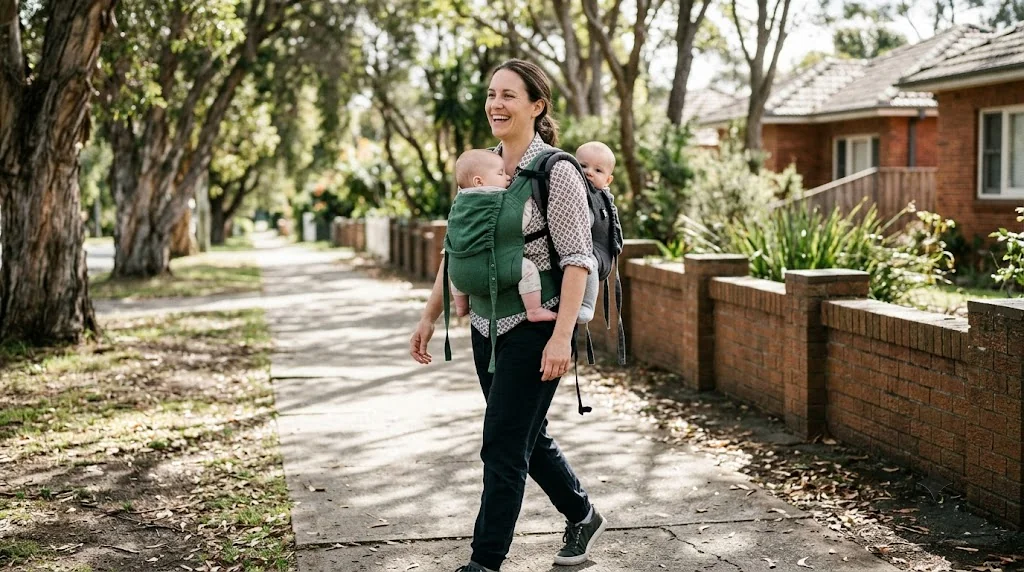
- Two single carriers. One carer wears both, one on the front and one on the back, which suits older babies with stronger head and trunk control. Or two carers take one each, which is simpler and spreads the load.
- A dedicated twin carrier. Designed to hold two at once, usually side by side or front and back, with the panels and straps engineered for the combined weight.
- Wraps or slings. A separate wrap or sling for each baby, which is adaptable to newborns and to different sizes as the babies grow.
Wearing two safely
The same safety principles apply whether you wear one baby or two. The widely used T.I.C.K.S. checklist is the standard babywearing reference, and it is worth running through every time you put a baby in a carrier.
- Tight. The carrier holds each baby close, with no slack that lets them slump.
- In view at all times. You can see each baby's face by glancing down.
- Close enough to kiss. Each baby's head is close enough to tip your chin and kiss the top.
- Keep chin off the chest. There is a finger's width under the chin so the airway stays open.
- Supported back. Each baby is held snug against you, back gently supported in its natural position.
Newborns need extra head and airway support, and front-and-back carrying is generally for once babies have stronger head control rather than the early weeks. If you are unsure about a particular carrier, a baby's readiness, or your setup, check with a health provider or a babywearing consultant. The Australian Multiple Birth Association is also a good source of local, twin-specific support.
Why carriers are a smart pre-loved buy
Carriers hold their value and their function well. They are built to be durable, and they are easy to inspect: check the buckles click and lock, the seams are intact, and the fabric has no thinning or fraying at the stress points. Wash per the manufacturer's instructions before first use.
With twins you may want two carriers, or a single plus a wrap, and buying new twice adds up quickly. Second-hand keeps that cost down on gear your babies will use for a matter of months.
Before first use
Buckles that click and lock, seams and stitching intact, no thinning or fraying fabric, and a wash per the care label. A carrier that passes those checks is a carrier you can trust.
References
Babywearing safety and readiness vary by baby and by carrier, so treat the guidance above as a starting point and check with a professional if unsure.
- Pregnancy, Birth and Baby (Healthdirect), Raising and feeding twins
- Australian Multiple Birth Association (national support organisation for families with twins and multiples).
Related reading
Carry two for less
Find pre-loved carriers and wraps, then pass them on when your twins have grown out of them.
Shop the marketplace