
Two cots or one? Setting up sleep for twins
When twins can share a sleep space and when they need their own, the safe-sleep basics that apply to each baby, and the standard every cot must meet.
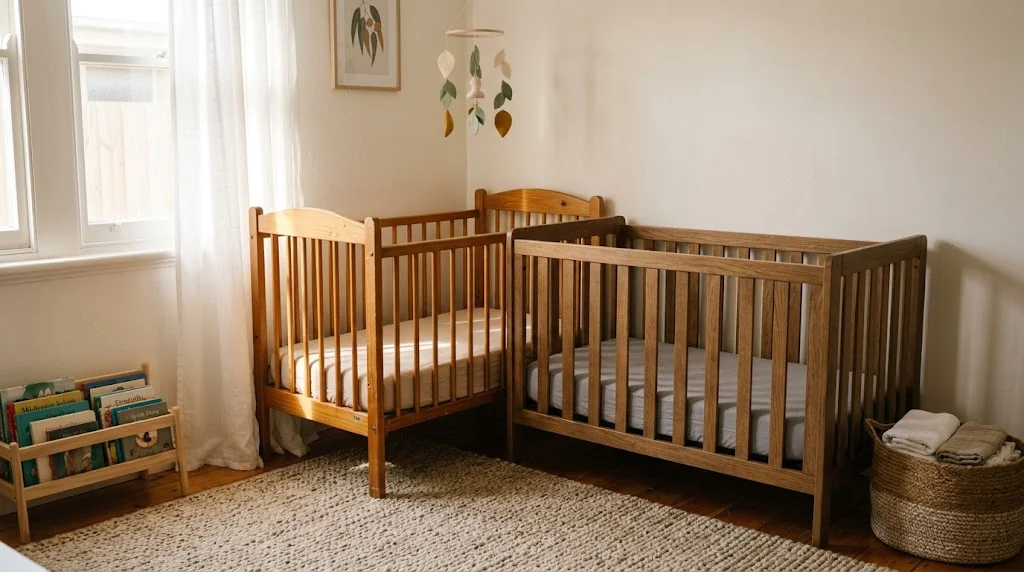
The question every twin parent asks
Do we need two cots from day one? It is one of the first big questions when you are expecting twins, and the honest answer is that it depends on the babies and on the advice you are following at the time. In the newborn weeks many families use one shared bassinet or cot, then move to two cots as the babies grow and start to move and roll. There is no single moment that fits every set of twins, so this is a conversation to have with your own health provider rather than a rule to copy from a blog.
Practices around co-bedding vary, and current safe-sleep advice should be followed for each baby whether they share a space or not. The most reliable guidance in Australia comes from Red Nose, safe sleeping, which is the authority to defer to, alongside your midwife, maternal and child health nurse or doctor. If anything here differs from what they tell you, follow them.
Safe-sleep basics for each baby
Whether your twins share one cot for a while or have two from the start, the safe-sleep basics apply to each baby individually. Red Nose advises that each baby sleeps on their back, on a firm flat surface, with their own clear sleep space. Position each baby with their feet to the bottom of the cot so they cannot wriggle down under bedding, keep the face and head uncovered, and use no soft or loose bedding, pillows or bumpers.
- Each baby on their back, every sleep.
- A firm, flat sleep surface, with a firm well-fitting mattress.
- Each baby with their own clear sleep space.
- Feet positioned to the bottom of the cot.
- Face and head uncovered.
- No soft or loose bedding, pillows or bumpers.
These apply the same way to one shared cot and to two separate cots. The number of cots does not change the basics; it only changes how much space each baby has as they grow.
The standard every cot must meet
Any cot you use, new or second-hand, must meet the mandatory Australian and New Zealand standard AS/NZS 2172. That is not optional, and it is the first thing to confirm before anything else. If you are buying pre-loved, our guide on whether a used cot is safe walks through the full set of checks: the compliance label, safe bar spacing, no protruding hazards, sound structure and its own firm, well-fitting mattress. With twins you simply run those checks twice, once for each cot.
Check each cot separately
Two cots means two sets of checks. Read what AS/NZS 2172 actually means and apply it to each cot in turn. Anything you cannot verify on either cot, leave.
The cost of doubling up
Two cots is one of the bigger lines in a twin budget, because it is one of the few items you genuinely need two of. A standards-compliant cot bought pre-loved, a modern cot in good condition checked against AS/NZS 2172, cuts that line close to half. Cots are also a durable, easy-to-inspect used buy: solid timber, few moving parts, and a compliance label you can confirm by eye. That makes them one of the more sensible things to buy second-hand for twins, as long as the safety checks pass on both.
Safe sleep comes first and cost comes second. Get the checks right, follow Red Nose and your health provider for each baby, and buying pre-loved becomes a way to set up two safe cots without paying twice at full retail.
References
Safe-sleep practices vary and are best confirmed with your own health provider. Follow current Red Nose advice for each baby.
- Red Nose, Safe sleeping (Australia's authority on safe infant sleep; follow current advice for each baby).
- Australian Multiple Birth Association (support and information for families with twins and multiples).
Related reading
Two safe cots, not double the cost
Once each cot passes its checks, buying pre-loved sets up both sleep spaces for a fraction of retail. See what other families are passing on.
Shop the marketplace