
Twin birth in Australia: what to expect
Vaginal or caesarean, why so many twins arrive early, and what a special care nursery stay actually involves, without the alarm.
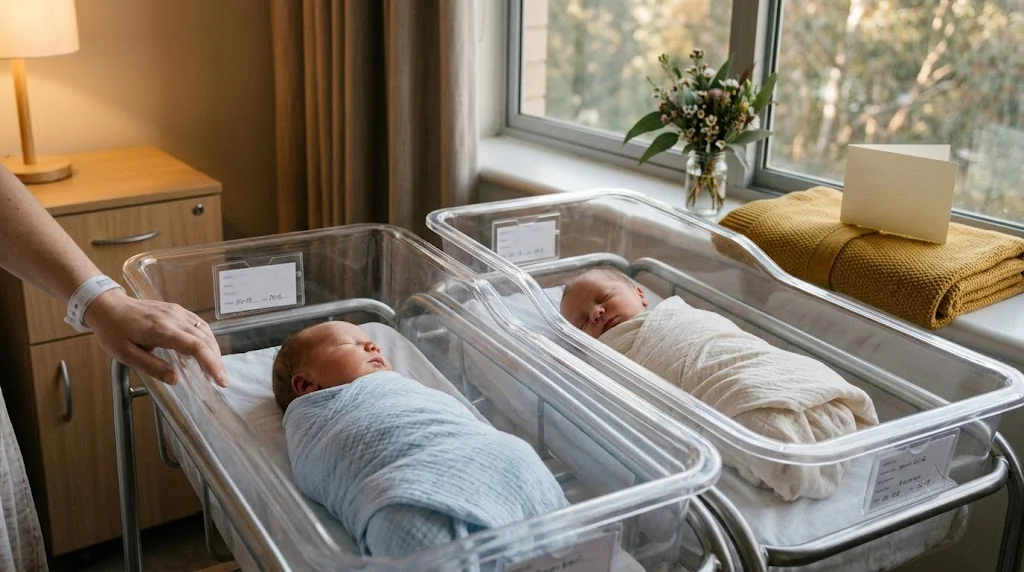
Vaginal or caesarean
A common worry is that twins always mean a caesarean. They don't, but the odds do shift. About one in three sets of twins in Australia are born vaginally, which means roughly two-thirds arrive by caesarean, and twin parents are about twice as likely to have a caesarean as parents of a single baby (Pregnancy, Birth and Baby).
The mode of birth depends on factors like the position of the first twin, how far along the pregnancy is, and your own health and history. It isn't a fixed rule so much as a decision you make with your care team as things unfold, and it can change on the day.
Why the caesarean rate has climbed
It helps to know this is a trend, not a coincidence. In Victoria, vaginal twin births fell from about 76% in 1983 to about 29% by 2015, with caesareans roughly tripling over that period and most of the change happening before 2005 (RANZCOG O&G Magazine).
The point isn't that one path is better than the other. It's that a caesarean is now the more common outcome for twins, so it's worth understanding early rather than treating it as a surprise or a setback if it happens to you.
Twins tend to arrive early
Full term for twins is generally 37 to 38 weeks, earlier than the 40 weeks you might have in mind for a single baby. Many twins come sooner still. Of babies from multiple births, 63% were born preterm in the latest figures, up from 58% in 2010, and 54% were low birthweight (AIHW, 2023 data).
That same data shows 62% of babies from multiple births were admitted to a special care nursery or neonatal intensive care unit. Put plainly: more than half of twins spend some time in specialised newborn care. It is the common path, not the exception.
What a special care nursery stay involves
A special care nursery, or SCN, and its more intensive counterpart the NICU can sound frightening before you've seen one. In practice, a stay for twins is often about feeding support, keeping small babies warm, and monitoring rather than anything dramatic. Babies born a few weeks early may simply need a little help learning to feed and hold their temperature before they come home.
Staff will guide you through it, and you can still be closely involved with your babies. A stay in special care is a normal part of the twin path for many families, not a failure or a sign something has gone wrong. If your babies do spend time there, you'll be in good company.
The honest picture
Two-thirds of twins arrive by caesarean, most arrive early, and more than half spend time in special care. None of that means anything has gone wrong. It's the ordinary shape of a twin birth, and your care team plans for it.
Being ready a little sooner
Because more than half of twins arrive early and spend time in special care, having the essentials ready sooner tends to take the pressure off. Buying pre-loved lets you prepare two of everything without the double bill hanging over an early arrival or a hospital stay, so the gear is one less thing on your mind.
References
This post is general information, not medical advice. Your birth is personal, so decisions about mode of birth and newborn care are ones to make with your midwife, obstetrician and care team.
Related reading
Prepare for two, sooner
Twins often arrive early. Getting two of everything pre-loved means you're ready ahead of time, without the double bill.
Shop the marketplace